Free Credit Dispute Letter Template: A Minnesota Consumer's Guide

Free Credit Dispute Letter Template: A Minnesota Consumer's Guide
Category: Credit Education • Reading Time: 10 min read • Author: Carlos Hawkins, Founder of AIM Credit Repair LLC
IMPORTANT DISCLOSURE
AIM Credit Repair LLC is a credit services organization, not a law firm, and does not provide legal advice. You have the right to dispute inaccurate information on your credit report for free by contacting the credit bureaus directly. You are not required to use a credit repair company or hire anyone to assist you with this process.
For free resources and information about your rights, visit:
- Consumer Financial Protection Bureau: consumerfinance.gov
- Federal Trade Commission: consumer.ftc.gov
- Minnesota Attorney General Consumer Protection: ag.state.mn.us
Minnesota Residents: Under the Minnesota Credit Services Organization Act, you have the right to cancel any credit services agreement within five days, as provided by Minnesota law, without penalty. You will not be charged any fees before services are performed.
Key takeaways
- You can dispute credit report errors yourself, for free. It is a right under the Fair Credit Reporting Act. No company can charge you for it.
- The full letter template is in this article, below, with nothing to buy or sign up for.
- Each bureau must be disputed separately. The same error often appears on one report and not the others.
- Also dispute with the company that reported the item. This step is skipped constantly and is often more effective.
- Bureaus generally have 30 days to investigate, extending to 45 if you send more information mid-investigation.
- Accurate negative information cannot be removed by any letter or any company.
This article gives you the letter. No email required, nothing to buy, no account to create. Copy it, fill in your details, and send it.
We are a credit repair company, so it is fair to ask why we would hand this over. The honest answer is that federal law requires us to tell you that you can do this yourself for free, and we would rather do that properly than bury it in fine print. If you can resolve your own report with a letter and a stamp, you should. If you would rather have help managing it, that offer is at the end, and it is genuinely optional.
Written by Carlos Hawkins, founder of AIM Credit Repair LLC, a Minnesota credit services organization registered under Minnesota Statutes §§ 332.52–332.60 and accredited by the Better Business Bureau. AIM has guided Minnesota consumers through the bureau dispute process since the company was founded, and this template reflects the same statutory language and structure used in that work. AIM's approach to consumer credit has been covered by the Minnesota Spokesman-Recorder.
Before You Write Anything, Get Your Reports
You cannot dispute what you have not read. Start with the only federally authorized source for free credit reports:
That site is the one authorized under federal law. Anything charging you for your annual report is not it. Pull all three reports, from Equifax, Experian, and TransUnion, because the same error very often appears on one report and not the others, and each bureau has to be disputed separately.
Read each report line by line and write down anything that looks wrong. If you are not sure what counts as an error, our guide to the 5 most common credit report errors in Minnesota walks through what to look for.
What Actually Makes a Dispute Work
Before the template, understand what you are doing, because this is where most people go wrong.
A dispute is a factual claim, not an argument. You are telling the bureau that a specific piece of information is inaccurate, incomplete, or cannot be verified. The strongest disputes are specific and boring: this account is not mine, this balance is wrong, this was paid on this date, this was discharged in bankruptcy.
Documentation carries the weight. A letter alone states a position. A letter with a payment confirmation, a settlement agreement, or a court document attached gives the investigator something concrete to check.
Dispute one thing at a time. A letter listing eleven grievances tends to get processed as a low-quality bulk dispute. One item per letter, or a small number of clearly separated items, reads as legitimate and is easier to investigate.
Accurate negative information is not going anywhere. If a late payment genuinely happened, no letter removes it. Most negative items stay on your report for up to seven years, and most bankruptcies up to ten. Any service promising to erase accurate history is describing something the law does not allow.
That last point is worth repeating because an entire industry sells around it. The so-called "609 letter" is marketed as a legal loophole that forces deletion. It is not. Section 609 of the Fair Credit Reporting Act is about your right to access information in your file. We cover why those templates disappoint people in our breakdown of how credit repair actually works.
The Template
Copy everything between the lines. Replace every bracketed field with your own information. Delete any line that does not apply.
[Your Full Legal Name]
[Your Street Address]
[City, State, ZIP]
[Date]

[Credit Bureau Name]
[Credit Bureau Address]

RE: Dispute of Inaccurate Information
Report Confirmation Number (if available): [Number]

To Whom It May Concern:

I am writing to dispute inaccurate information appearing on my credit
report. After reviewing my credit file, I identified the following
account or item that I believe contains inaccurate information:

  Account or Item Name: [Creditor or Collection Agency Name]
  Account Number:       [Partial Account Number as Shown on Credit Report]
  Reason for Dispute:   [Clearly explain the specific factual inaccuracy.]

For example:

  - This account does not belong to me.
  - This account was paid in full on [date], but it is still being
    reported with an outstanding balance.
  - The reported balance is $[reported amount], but the correct balance
    is $[correct amount].
  - This account was included in a bankruptcy that was discharged on
    [date].
  - The payment history for [month/year] is being reported as late, but
    the payment was made on time.

To support my dispute, I have enclosed copies of the following
documentation:

  - [Payment receipt or confirmation dated ______]
  - [Settlement or paid-in-full letter from ______]
  - [Account statement or other supporting record]
  - [Bankruptcy discharge documentation, if applicable]
  - [Identity theft documentation, if applicable]
  - [Copy of government-issued identification, if needed]
  - [Proof of current address, if needed]

Under Section 611 of the Fair Credit Reporting Act (FCRA), I am
requesting that you conduct a reasonable investigation into the disputed
information and correct or delete any information that cannot be
verified as accurate and complete.

Upon completion of your investigation, please provide me with written
notification of the results and an updated copy of my credit report
reflecting any changes made as a result of this dispute.

If the disputed information is verified and continues to be reported, I
also request a description of the procedure used to determine the
accuracy and completeness of the information, including the name,
address, and telephone number of the furnisher contacted, if reasonably
available, pursuant to Section 611(a)(7) of the FCRA.

Thank you for your attention to this matter. I can be reached at the
mailing address listed above.

Sincerely,

[Signature]
[Your Printed Full Legal Name]
Last Four Digits of SSN: XXX-XX-[____]
Date of Birth: [MM/DD/YYYY]

Enclosures: [Number] documents
Prefer to fill it in on your computer? Download the editable Word version — free, no email required. It includes this letter, the checklist below, and all three bureau addresses.
Notes on filling it in
Send copies, never originals. You will not get documents back.
Do not include your full Social Security number. The last four digits are enough for the bureaus to match your file, and it limits your exposure if the letter is mishandled.
Keep the reason short and factual. "This account does not belong to me" is stronger than three paragraphs explaining your circumstances. Investigators are processing volume. Give them the fact.
Keep a complete copy of everything you send, including the enclosures, with the date you mailed it.
Where to Send It
Each bureau investigates separately, so an error appearing on all three reports needs three letters.
| Bureau | Mailing address | Online |
|---|---|---|
| Experian | P.O. Box 4500, Allen, TX 75013 | experian.com/disputes |
| TransUnion | P.O. Box 2000, Chester, PA 19022-2000 | transunion.com/credit-disputes |
| Equifax | P.O. Box 740256, Atlanta, GA 30374 | equifax.com/personal/credit-report-services |
Mailing addresses do change. Confirm the current one on the bureau's own website before you send anything.
Mail or online: which to choose
Your investigation rights under the Fair Credit Reporting Act are identical either way. The difference is practical, not legal.
| Certified mail | Online portal | |
|---|---|---|
| Speed | Slower, add mailing time each way | Immediate submission and confirmation |
| Proof of delivery | Independent, dated return receipt | Portal confirmation only, controlled by the bureau |
| Attaching documents | Paper copies, no size limits | Uploads, sometimes with file type or size caps |
| Best for | Significant items, or anything you have disputed before without resolution | A first pass at a clear, well-documented error |
| Cost | A few dollars per letter, per bureau | Free |
If an item matters and you have disputed it before, the certified mail receipt is the thing you will wish you had. For a straightforward first dispute, the online portal is faster and costs nothing.
Also Dispute With the Company That Reported It
This step gets skipped constantly, and it is often the more effective one.
The business that furnished the information to the bureau, the lender, the collection agency, the hospital, has its own obligation under the Fair Credit Reporting Act to investigate disputes it receives directly. Send the same letter to them, addressed to their billing or credit reporting department.
If the furnisher corrects its records at the source, the correction flows to every bureau it reports to. Fixing the source can resolve in one action what would otherwise take three separate bureau disputes.
What Happens After You Send It
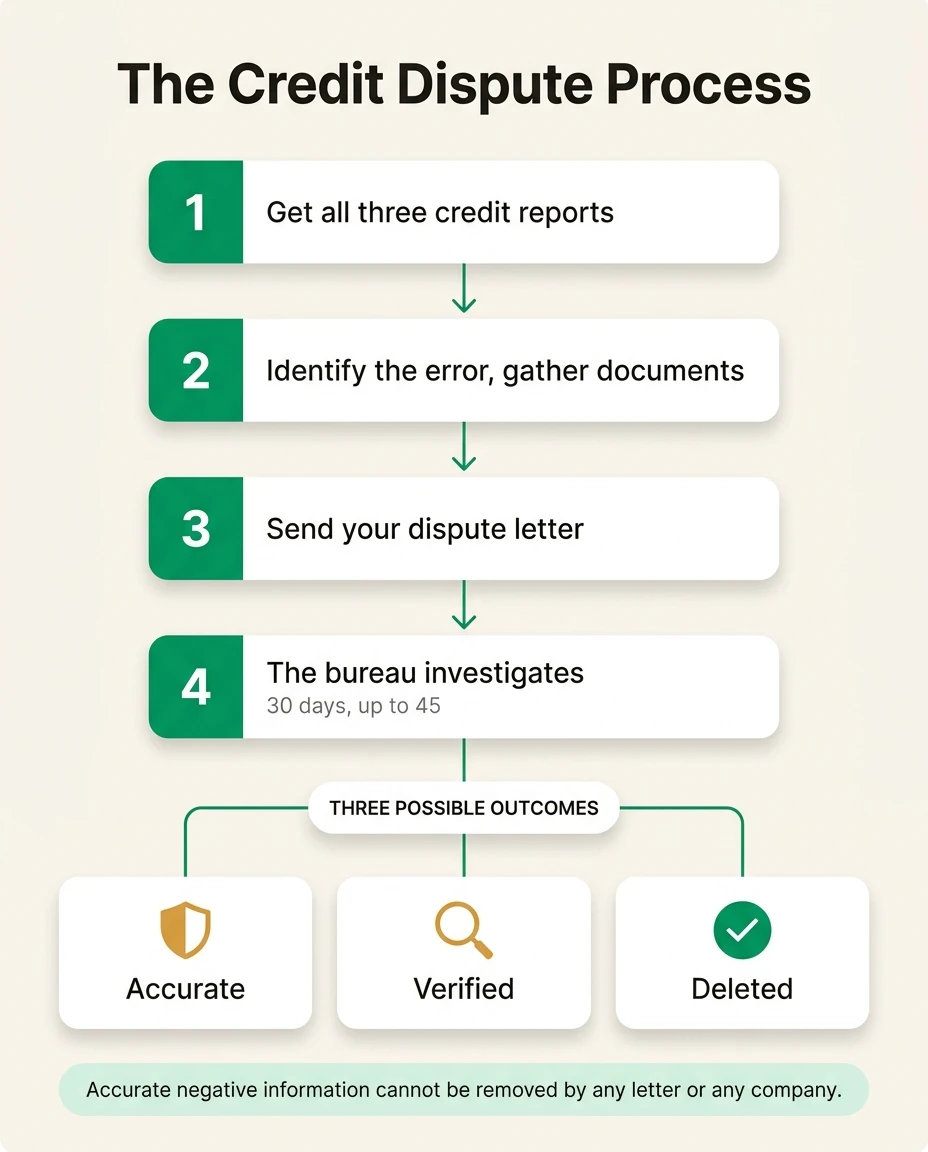
The credit bureau generally has 30 days to investigate. If you send additional information after filing, that window can extend to 45 days.
These are the statutory deadlines for the investigation itself. They describe the process, not the result. Nobody can tell you in advance what an investigation will conclude, and outcomes vary from person to person.
You will receive written results. The bureau reports one of three outcomes for the item:
Accurate. The bureau found the information correct as reported. The item stays on your report unchanged.
Verified. The furnisher was contacted and confirmed the information. As with an accurate result, the item stays on your report. If you still believe it is wrong, keep reading.
Deleted. The item was removed from your report entirely. This is the outcome most people are hoping for, and it happens when the information cannot be verified as accurate and complete.
One thing that is not an outcome, but does happen: a dispute can be rejected as frivolous before it is investigated at all. That usually follows bulk, undocumented, or repeatedly resubmitted disputes. It is the main reason to send a small number of well-documented items rather than everything at once.
If the Item Comes Back "Verified"
A verified result is not the end of the road. Your options:
- Request the method of verification. The template above already asks for this. You are entitled to a description of the procedure used and the furnisher's contact details.
- Dispute directly with the furnisher, if you have not already.
- Add a statement to your file. You can include a brief explanation in your credit file. It will not change your score, but anyone reading the report manually will see your side.
- File a complaint. The Consumer Financial Protection Bureau accepts complaints about both bureaus and furnishers. Minnesota residents can also contact the Minnesota Attorney General's Office.
- Talk to a consumer attorney. If a bureau repeatedly reports information you can document as false, that may be a legal matter. We are not a law firm and cannot advise you on that.
Your Rights as a Minnesota Resident
Minnesota adds protections on top of federal law. These apply to any credit services organization operating in the state, including us.
| Your right | What it means |
|---|---|
| 5-day cancellation | You may cancel any credit services agreement within five days, as provided by Minnesota law, without penalty and without giving a reason. |
| No advance fees | A company cannot charge you before services are actually performed. |
| Written contract | You are entitled to a written agreement describing the services and total cost before any work begins. |
| Free self-service | Any company must disclose that you can dispute items yourself, for free, and are never required to hire anyone. |
| No guaranteed outcomes | No company may promise a specific score increase or guarantee removal of accurate information. |
If a company you are considering breaks any of these, that is not a warning sign. It is a violation, and you can report it to the Minnesota Attorney General.
When Hiring Help Actually Makes Sense
Most people with one or two clear errors and the documentation to prove them should send the letter above and keep their money.
Where a service earns its fee is volume and follow-through: several items across all three bureaus, multiple 30-day cycles to track, furnishers to chase separately, and results to document as they come back. That is administrative work, and it is the part people abandon halfway through.
What no legitimate company can offer is a different legal outcome. We dispute under exactly the same statutes you would use, with the same investigation windows and the same rules about accurate information. Anyone claiming leverage you do not have is selling something the law does not permit.
If you want to talk it through, a consultation is free and we will tell you honestly if you are better off handling it yourself. Results vary in every case, and we do not promise otherwise.
This article is educational and is not legal advice. AIM Credit Repair LLC is a credit services organization, not a law firm. Individual results vary. For free information about your rights, visit consumerfinance.gov or the Minnesota Attorney General's Office.
Frequently asked questions
What is a sample credit dispute letter?
A credit dispute letter is a written notice to a credit bureau stating that specific information in your credit file appears inaccurate, incomplete, or unverifiable, and asking them to investigate it. Under the Fair Credit Reporting Act, sending one triggers a formal investigation, generally within 30 days. You can write and send one yourself at no cost. A template gives you the structure, but the details and any supporting documents have to be your own.
Do I have to pay someone to dispute a credit report error?
No. You have the right to dispute inaccurate information on your credit report yourself, for free, by contacting the credit bureaus directly. This is a right guaranteed under the Fair Credit Reporting Act. No company can charge you for a right you already have. Some people choose to hire help for organization and follow-through, but it is never a requirement.
Is it better to dispute online or by mail?
Both are valid. Online portals are faster and give you immediate confirmation. Mailing a letter using certified mail with return receipt creates independent, dated proof that the bureau received your dispute, which some people prefer if the item is significant or if they have disputed it before without resolution. The investigation rights are the same either way.
What happens if the credit bureau says the item was verified?
If a bureau reports an item as verified and you still believe it is wrong, you have options. You can request a description of the method of verification they used, dispute directly with the company that furnished the information, add a brief statement to your file, or file a complaint with the Consumer Financial Protection Bureau or the Minnesota Attorney General's Office. A verified result is not necessarily the end of the process.
How long does a credit dispute investigation take?
Under the Fair Credit Reporting Act, credit bureaus generally have 30 days to investigate a dispute. That window can extend to 45 days if you send additional information after filing. These are the statutory timelines for the investigation itself. They are not a prediction of any particular outcome, and results vary from person to person.
Do 609 dispute letters remove accurate negative items?
No. Section 609 of the Fair Credit Reporting Act covers your right to request and access information in your file. It is not a loophole that forces deletion of accurate information. Letters sold as 609 templates are widely overhyped. Accurate, well-documented disputes of genuinely incorrect information are what the law actually supports.