
Credit Restoration vs Credit Repair: Is There Actually a Difference?

Credit Restoration vs Credit Repair: Is There Actually a Difference?
Category: Credit Education • Reading Time: 8 min read • Author: Carlos Hawkins, Founder of AIM Credit Repair LLC
IMPORTANT DISCLOSURE
AIM Credit Repair LLC is a credit services organization, not a law firm, and does not provide legal advice. You have the right to dispute inaccurate information on your credit report for free by contacting the credit bureaus directly. You are not required to use a credit repair company or hire anyone to assist you with this process.
For free resources and information about your rights, visit:
- Consumer Financial Protection Bureau: consumerfinance.gov
- Federal Trade Commission: consumer.ftc.gov
- Minnesota Attorney General Consumer Protection: ag.state.mn.us
Minnesota Residents: Under the Minnesota Credit Services Organization Act, you have the right to cancel any credit services agreement within five days, as provided by Minnesota law, without penalty. You will not be charged any fees before services are performed.
Key takeaways
- They are the same service. The difference is vocabulary, not substance.
- "Credit repair" is a legal term. "Credit restoration" is not. Neither the federal statute nor Minnesota's contains the phrase "credit restoration" anywhere.
- Both laws define these businesses by what they do, not by what they call themselves. The label changes nothing.
- Your protections travel with the service. No advance fees, written contract, no guaranteed outcomes, and a 5 business day cancellation right in Minnesota, whichever word is on the website.
- Neither one can remove accurate information. No vocabulary changes that.
The short answer
Credit restoration and credit repair are the same service. Reviewing your credit reports, disputing information that appears inaccurate, incomplete, or unverifiable, and helping you build habits that hold the improvement.
The difference is that one of those phrases appears in the law and the other does not. "Credit repair" is a defined legal term with a body of consumer protection attached to it. "Credit restoration" is a marketing choice.
Here is the part worth knowing: that does not weaken your protections. A company calling itself a credit restoration service is still bound by every rule that governs credit repair. The law does not care what a business calls itself. It cares what the business does.
What the law actually says
This is checkable, and it is worth checking, because it is the whole basis of the answer.
Federal law
The Credit Repair Organizations Act, at 15 U.S.C. §1679a(3), defines a credit repair organization as any person who sells or performs services:
"for the express or implied purpose of improving any consumer's credit record, credit history, or credit rating"
Read that again and notice what it does not say. It does not say "any business that calls itself a credit repair company." It describes a function. If a company sells you a service whose purpose is improving your credit record, it is a credit repair organization under federal law, and it does not matter what appears on its website.
Minnesota law
Minnesota adds its own layer through the Credit Services Organization Act, Minnesota Statutes §§ 332.52–332.60. Section 332.52 defines a credit services organization as a person who sells or performs services to:
"improve a buyer's credit record, history, or rating"
Same structure. Defined by function, not by name.
Neither statute mentions "restoration"
The phrase "credit restoration" does not appear in either law. Not as a defined term, not as a category, not as an exception. It has no legal existence.
Why this matters to you
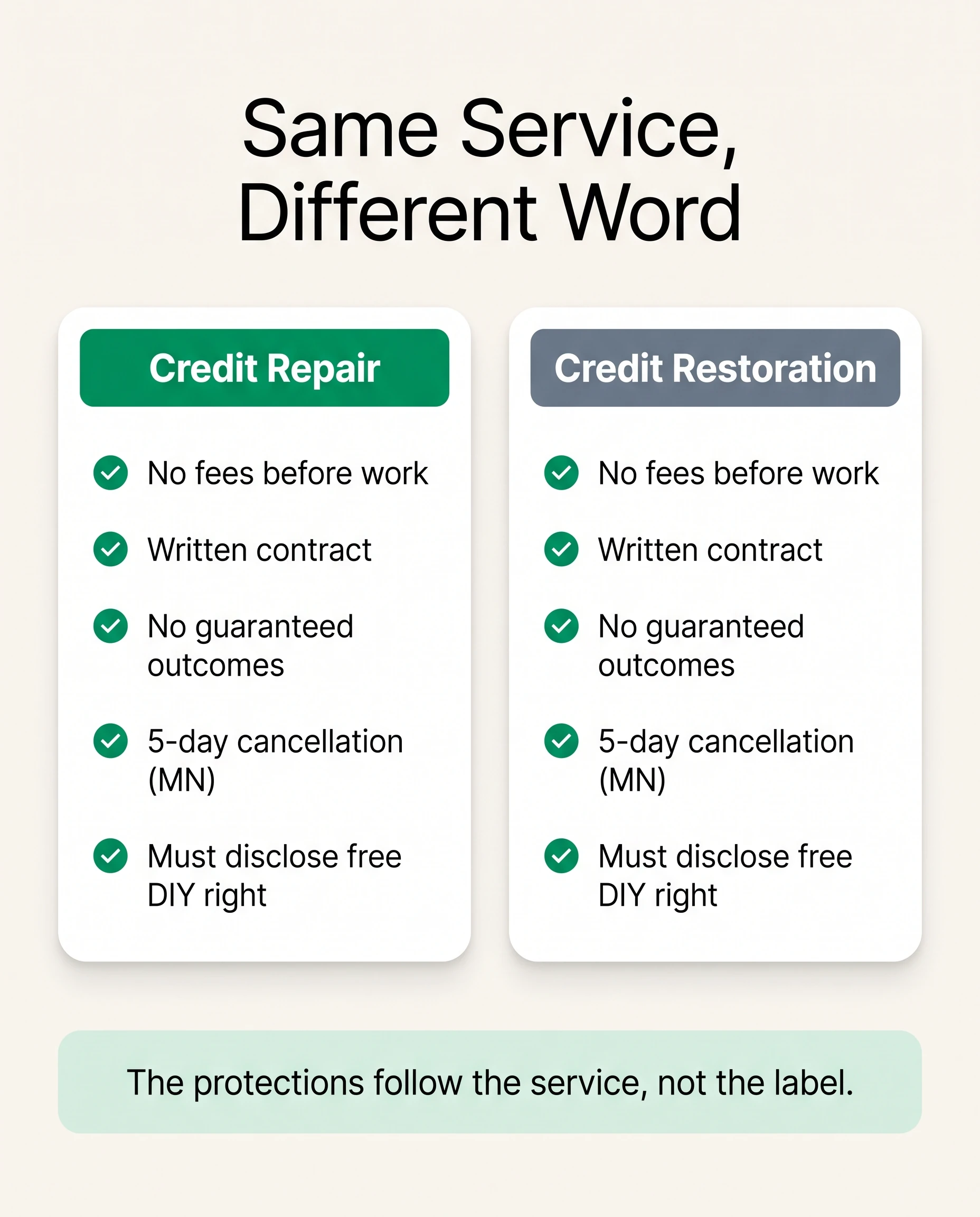
Because the definitions are functional, the protections follow the service rather than the label. A company advertising credit restoration in Minnesota is subject to all of this:
| Your protection | Applies to "restoration" companies? |
|---|---|
| No fees before services are performed | Yes |
| Written contract before work begins | Yes |
| No guaranteed scores or outcomes | Yes |
| 5 business day cancellation right (Minnesota) | Yes |
| Must disclose you can dispute yourself for free | Yes |
| Registration with the Minnesota Department of Commerce | Yes |
If a company describes itself as a restoration service and then asks for payment before doing any work, that is not a different business model. It is the same violation it would be under any other name.
The risk is not the word. The risk is a consumer assuming the word signals something different, less regulated, or outside the rules, and dropping their guard because of it.
So why does the industry use "restoration"?
Two reasons, and neither is sinister.
It sounds less like something is broken. "Repair" implies damage. "Restoration" implies returning something to its proper state. For someone who feels ashamed about their credit, the second word lands more gently. That is a reasonable instinct.
And "credit repair" has a reputation problem. The category has produced enough bad actors that the phrase itself carries baggage. Companies that follow the rules carry the reputational cost of companies that do not. Reaching for a different word is an understandable response.
Neither reason makes a company using it dishonest. Plenty of legitimate operators say restoration. The point is only that the word tells you nothing about whether they follow the rules, so you have to check the things that do.
The same thing happens on the other side of the phone
I see this from the creditor's side too, and it is the clearest proof I know that the word is never the thing.
When someone negotiates a settlement on a charged-off account, some creditors will say on that call whether they are willing to stop reporting it. Almost none of them will use the word "delete." What you hear instead is "tradeline forgiveness," or that they will "remove it from reporting." Different phrases for the same action, chosen because "delete" is a word the industry avoids saying out loud.
That is worth knowing for a practical reason. If you are settling an account, have that conversation during the negotiation rather than after it. Whether it goes anywhere depends a great deal on which creditor or collection agency you are dealing with, and nobody can promise you an outcome. But it is a much harder conversation to start once the money has already changed hands.
Please note that settlement of an account does not guarantee removal from your credit report. Any tradeline forgiveness, deletion, or removal is ultimately at the discretion of the creditor or collection company. While AIM Credit Repair may attempt to negotiate for deletion when appropriate, not every settlement will result in the account being removed from your credit report.
The pattern generalizes, which is really the point of this whole article. In this industry the vocabulary moves around constantly while the substance underneath stays fixed. "Restoration" instead of "repair" on the marketing side. "Forgiveness" instead of "deletion" on the creditor side. In both cases the only question worth asking is the same one: what is actually being done here, and what rules govern it?
What neither one can do
No matter which word a company uses, none of this changes:
Accurate information stays. If a late payment genuinely happened, no dispute removes it. Most negative items remain on your report for up to seven years, and most bankruptcies up to ten.
No one can promise a number. A specific score by a specific date is not a promise a company is permitted to make, under either name.
Nobody has special access. There is no back channel to the bureaus, no relationship that speeds up an investigation, no letter template that forces deletions. The process is the same one described in how credit repair works in Minnesota, and you can run it yourself using our free dispute letter template.
Where a real difference does exist: credit counseling
It is worth naming the one nearby term that is genuinely a different service, because people meet all three words in the same search and reasonably assume all three mean different things.
Credit counseling is not credit repair under another name. It addresses debt you actually owe, usually through budgeting help or a debt management plan that consolidates payments to your creditors. Many credit counseling agencies are non-profits, and non-profit organizations are specifically excluded from the federal definition above.
Credit repair, under either label, addresses the accuracy of what appears on your reports. Counseling addresses the debt itself.
That distinction is real, and it matters, because the two solve different problems. If your reports are accurate and the balances are genuinely yours, disputing items will not help you, and a counseling agency may serve you far better than we would. If your reports contain errors, counseling will not fix those.
Some people need both. A company that tells you honestly which one your situation calls for is worth more than one that sells you whichever it happens to offer.
How to judge a company, whatever it calls itself
Ignore the vocabulary entirely and check five things you can verify:
- Registered with the Minnesota Department of Commerce as a credit services organization
- Published pricing, rather than a number they will only give you on a call
- No fees before work is performed
- A written contract before anything begins, including the cancellation right
- They tell you plainly that you can dispute errors yourself, for free
A company passing all five is playing by the rules regardless of what it calls its service. One failing any of them has told you something useful.
We go through this in more detail in our guide to choosing a credit repair company, which works as a checklist for any company serving the Twin Cities.
Where we sit
We use "credit repair" because it is the legal term, and because we would rather be plain than appealing.
AIM Credit Repair LLC is registered with the Minnesota Department of Commerce under Minnesota Statutes §§ 332.52–332.60 and accredited by the Better Business Bureau. We publish our pricing. We do not charge before work is performed. And we put our full dispute letter on this site for anyone to copy, free, because you should be able to do this without us if you want to.
If you have found us searching for credit restoration, you are in the right place. It is the same work. We just call it what the statute calls it.
Written by Carlos Hawkins, founder of AIM Credit Repair LLC, serving Twin Cities clients for more than eight years. AIM's approach to consumer credit has been covered by the Minnesota Spokesman-Recorder.
This article is educational and is not legal advice. AIM Credit Repair LLC is a credit services organization, not a law firm. Individual results vary. For free information about your rights, visit consumerfinance.gov or the Minnesota Attorney General's Office.
Frequently asked questions
Is credit restoration the same as credit repair?
Yes. They describe the same service: reviewing your credit reports, disputing information that is inaccurate, incomplete, or unverifiable, and helping you build habits that hold the improvement. The difference is vocabulary, not substance. "Credit repair" is the term used in federal and Minnesota law. "Credit restoration" is a marketing choice.
Is "credit restoration" a legal term?
No. Neither the federal Credit Repair Organizations Act nor Minnesota's Credit Services Organization Act uses the phrase "credit restoration" anywhere. Both statutes define these businesses by what they do rather than by what they call themselves, which means the label carries no legal weight at all.
Does a credit restoration company have to follow the same rules?
Yes, and this is the part that matters most. Because both laws define the business by its function, a company advertising "credit restoration" is still a credit repair organization federally and a credit services organization under Minnesota law. Every rule applies: no fees before services are performed, a written contract before work begins, no guaranteed outcomes, and in Minnesota a five business day right to cancel.
Is credit restoration more expensive than credit repair?
There is no inherent price difference, because there is no service difference. Pricing varies by company and by how much work a file needs. What is worth watching is not the word on the website but the fee structure underneath it, since charging before services are performed is prohibited regardless of what the service is called.
Can a credit restoration company remove accurate information?
No. No company can lawfully remove accurate, verifiable information from your credit report, whatever it calls itself. Most negative items remain for up to seven years and most bankruptcies up to ten. Any company suggesting otherwise is describing something the law does not permit.
Do I need a credit restoration company, or can I do it myself?
You can dispute inaccurate information yourself, directly with the credit bureaus, at no cost. That right exists under the Fair Credit Reporting Act and no company is required. Where a service earns its fee is volume and follow through across multiple items and multiple investigation cycles, not access to anything you lack.